Inpage Navigation Section: Overview
2024
Ninja 7 Hybrid
The world's first* strong hybrid** motorcycle offers riders a number of new riding experiences: a mid-size package with the instant acceleration of a 1,000cc-class supersport model from a standing start (with e-boost), fuel economy on par with the 250cc-class, and button-shift sport riding. With three different drive modes each offering a distinct riding character and numerous innovative features for riders to explore, the Ninja 7 Hybrid truly changes the game, ushering in a new era in riding experience.
* Mass production models (excluding scooters) from a major power sports manufacturer as of October 6, 2023, per Kawasaki Motors, Ltd. research.
** Strong hybrid systems combine an internal combustion engine (ICE) with an electric motor for powerful riding, and because of their large battery capacity they are able to run on electricity alone.
Colour
Editions of Ninja 7 Hybrid
Ninja 7 Hybrid
Show all
Show less
- Metallic Bright Silver / Metallic Matte Lime Green / Ebony
starting from £7,499.00
Inpage Navigation Section: Gallery
- asset0
- asset1
Inpage Navigation Section: Features & Specs
- Features
- Technologies
- Specifications
HEV (Hybrid Electric Vehicle)
Kawasaki hybrid electric vehicles feature power units that combine an internal combustion engine (ICE) with a compact traction motor to offer a range of performance possibilities and a number of new riding experiences.
HEV (Hybrid Electric Vehicle)
As the world moves towards Carbon Neutrality, Kawasaki is developing a number of future mobility solutions. With power units that combine an internal combustion engine (ICE) with a compact traction motor, Kawasaki hybrid electric vehicles offer the possibility of increased performance in a compact package, improved fuel economy, or zero-emission riding—or all of the above with multiple driving modes—all while maintaining the riding excitement for which Kawasaki motorcycles are known. And with numerous innovative features for riders to explore, like e-boost, button-shift sport riding and WALK Mode, Kawasaki hybrid models are ushering in a new era in riding experience.
Automated Manual Transmission
Kawasaki’s unique, electronically controlled transmission uses proprietary logic to smoothly shift gears and operate the clutch. With actuation of the gears and the hydraulic clutch carried out by the bike, the rider can focus on throttle control.
Automated Manual Transmission
Kawasaki’s unique, electronically controlled transmission uses proprietary logic to smoothly shift gears and operate the clutch. During upshifts and downshifts, the ECU manages engine and motor speed for a smooth, natural shifting feel. The fine throttle control and clutch lever operation riders use on a conventional motorcycle are all controlled by the bike.
With an automated manual transmission, both full-automatic and manual operation are possible. Gears are shifted by an electric shifter motor directed by the ECU. With full-automatic operation, shift signals are received from the ECU. With manual operation, the ECU sends signals to the shifter motor based on rider input via the shift buttons.
The hydraulic clutch is actuated by a dedicated oil pump controlled by a solenoid valve. The ECU determines when the clutch needs to be engaged (to receive driving force from the engine) or disengaged (to shift gears, or when stopped).
Unlike a conventional motorcycle, there is no clutch lever or shift pedal to operate. Since actuation of the gears and the hydraulic clutch is carried out by the bike, the rider can focus on throttle control—an advantage when executing U-turns and other low-speed manoeuvres, during very-low speed riding, and when riding in heavy stop-and-go traffic.
Additional systems like Button-Shift and ALPF (Automatic Launch Position Finder), which automatically returns the transmission to 1st gear when the vehicle stops to facilitate moving off again, can also be incorporated.
Button-Shift
With button-shift, the rider initiates gear shifts using the shift buttons on the left handle.
Button-Shift
Button-Shift is one of the new riding experiences offered by Kawasaki’s new HEV models. Instead of using a shift pedal to change gears, the rider initiates gear shifts using the shift buttons on the left handle. A finger switch on the far side is used to shift up; a thumb switch is used to shift down. Actuation of the gears and the hydraulic clutch is then carried out by the bike’s Automated Manual Transmission, which makes this feature possible.
WALK Mode (with Reverse)
WALK Mode assists with maneuvering in a parking lot. When engaged, opening the throttle moves the bike forward at walking speed. Closing the throttle past the “zero” point moves the bike in reverse.
WALK Mode (with Reverse)
This convenient mode assists with maneuvering in a parking lot. When engaged, opening the throttle moves the bike forward at walking speed. Closing the throttle past the “zero” point moves the bike in reverse.
With the bike stopped and the throttle closed, WALK Mode is activated by pressing and holding the WALK Mode button. Once activated, the screen background turns orange to clearly distinguish from normal operation.
Idling Stop Function
When the vehicle comes to a complete stop, the Idling Stop Function turns the engine off to conserve fuel.
Idling Stop Function
On models like the Ninja 7 Hybrid and Z7 Hybrid, the Idling Stop Function offers added convenience when riding in city traffic. When the vehicle comes to a complete stop, the engine turns off to conserve fuel.
Smartphone Connectivity
Smartphone connectivity contributes to an enhanced motorcycling experience by enabling riders to connect to their motorcycle wirelessly.
Smartphone Connectivity
Clever technology enables riders to connect to their motorcycle wirelessly. Using the smartphone application RIDEOLOGY THE APP a number of instrument functions can be accessed, contributing to an enhanced motorcycling experience. Vehicle information (such as the odometer, fuel gauge, maintenance schedule, etc) can be viewed on the smartphone. Riding logs (varies by model, but may include GPS route, gear position, rpm, and other information) can be viewed on the smartphone. When connected, telephone (call, mail) notices are displayed on the instrument panel. Riders can also make changes to their motorcycle instrument display settings (preferred units, clock and date setting, etc) via the smartphone. And on certain models, it is even possible to check and adjust vehicle settings (such as Rider Mode, electronic rider support features, and payload settings) using the smartphone.
Zero Emissions
When operating exclusively using the electric motor, no emissions are created.
Zero Emissions
When operating exclusively using the electric motor, no emissions are created.
e-boost Function
The e-boost function allows riders to briefly tap into extra power for stronger acceleration and a higher top speed.
e-boost Function
Unique to Kawasaki’s EV and HEV models, e-boost allows riders to briefly tap into extra power for stronger acceleration and a higher top speed.
To prevent battery overheating, e-boost operation is limited (time varies by model). When all conditions have been met, e-boost availability will be shown on the screen via indicator or the e-boost gauge. Pressing the button on the right handle activates the function, increasing power and torque. The e-boost gauge (now purple) counts down the remaining time available. Once the bike is ready again, the e-boost function can be activated once more.
e-boost can be activated on-the-fly (while riding) or when stopped.
ABS
ABS (Anti-lock Brake System) ensures stable braking performance by preventing wheel lock during braking.
ABS
Sudden over-application of the brakes, or braking on low-grip surfaces (surfaces with a low coefficient of friction) such as wet asphalt or manhole covers may cause a motorcycle's wheel(s) to lock up and slip. ABS was developed to prevent such incidents. Kawasaki ABS systems are controlled by high precision and highly reliable programming formulated based on thorough testing of numerous riding situations. By ensuring stable braking performance, they offer rider reassurance that contributes to greater riding enjoyment. And to meet the special requirements of certain riders, specialised ABS systems are also available. For example, KIBS (Kawasaki Intelligent anti-lock Brake System) is a high-precision brake system designed specifically for supersport models, enabling sport riding to be enjoyed by a wider range of riders. And by linking the front and rear brakes, K-ACT (Kawasaki Advanced Coactive-braking Technology) ABS provides the confidence to enjoy touring on heavyweight models. Kawasaki is continually working on the development of other advanced ABS systems.
- HEV (Hybrid Electric Vehicle)
- Automated Manual Transmission
- Button-Shift
- WALK Mode (with Reverse)
- Idling Stop Function
- Smartphone Connectivity
- Zero Emissions
- e-boost Function
- ABS
HEV (Hybrid Electric Vehicle)
Kawasaki hybrid electric vehicles feature power units that combine an internal combustion engine (ICE) with a compact traction motor to offer a range of performance possibilities and a number of new riding experiences.
HEV (Hybrid Electric Vehicle)
As the world moves towards Carbon Neutrality, Kawasaki is developing a number of future mobility solutions. With power units that combine an internal combustion engine (ICE) with a compact traction motor, Kawasaki hybrid electric vehicles offer the possibility of increased performance in a compact package, improved fuel economy, or zero-emission riding—or all of the above with multiple driving modes—all while maintaining the riding excitement for which Kawasaki motorcycles are known. And with numerous innovative features for riders to explore, like e-boost, button-shift sport riding and WALK Mode, Kawasaki hybrid models are ushering in a new era in riding experience.
Automated Manual Transmission
Kawasaki’s unique, electronically controlled transmission uses proprietary logic to smoothly shift gears and operate the clutch. With actuation of the gears and the hydraulic clutch carried out by the bike, the rider can focus on throttle control.
Automated Manual Transmission
Kawasaki’s unique, electronically controlled transmission uses proprietary logic to smoothly shift gears and operate the clutch. During upshifts and downshifts, the ECU manages engine and motor speed for a smooth, natural shifting feel. The fine throttle control and clutch lever operation riders use on a conventional motorcycle are all controlled by the bike.
With an automated manual transmission, both full-automatic and manual operation are possible. Gears are shifted by an electric shifter motor directed by the ECU. With full-automatic operation, shift signals are received from the ECU. With manual operation, the ECU sends signals to the shifter motor based on rider input via the shift buttons.
The hydraulic clutch is actuated by a dedicated oil pump controlled by a solenoid valve. The ECU determines when the clutch needs to be engaged (to receive driving force from the engine) or disengaged (to shift gears, or when stopped).
Unlike a conventional motorcycle, there is no clutch lever or shift pedal to operate. Since actuation of the gears and the hydraulic clutch is carried out by the bike, the rider can focus on throttle control—an advantage when executing U-turns and other low-speed manoeuvres, during very-low speed riding, and when riding in heavy stop-and-go traffic.
Additional systems like Button-Shift and ALPF (Automatic Launch Position Finder), which automatically returns the transmission to 1st gear when the vehicle stops to facilitate moving off again, can also be incorporated.
Button-Shift
With button-shift, the rider initiates gear shifts using the shift buttons on the left handle.
Button-Shift
Button-Shift is one of the new riding experiences offered by Kawasaki’s new HEV models. Instead of using a shift pedal to change gears, the rider initiates gear shifts using the shift buttons on the left handle. A finger switch on the far side is used to shift up; a thumb switch is used to shift down. Actuation of the gears and the hydraulic clutch is then carried out by the bike’s Automated Manual Transmission, which makes this feature possible.
WALK Mode (with Reverse)
WALK Mode assists with maneuvering in a parking lot. When engaged, opening the throttle moves the bike forward at walking speed. Closing the throttle past the “zero” point moves the bike in reverse.
WALK Mode (with Reverse)
This convenient mode assists with maneuvering in a parking lot. When engaged, opening the throttle moves the bike forward at walking speed. Closing the throttle past the “zero” point moves the bike in reverse.
With the bike stopped and the throttle closed, WALK Mode is activated by pressing and holding the WALK Mode button. Once activated, the screen background turns orange to clearly distinguish from normal operation.
Idling Stop Function
When the vehicle comes to a complete stop, the Idling Stop Function turns the engine off to conserve fuel.
Idling Stop Function
On models like the Ninja 7 Hybrid and Z7 Hybrid, the Idling Stop Function offers added convenience when riding in city traffic. When the vehicle comes to a complete stop, the engine turns off to conserve fuel.
Smartphone Connectivity
Smartphone connectivity contributes to an enhanced motorcycling experience by enabling riders to connect to their motorcycle wirelessly.
Smartphone Connectivity
Clever technology enables riders to connect to their motorcycle wirelessly. Using the smartphone application RIDEOLOGY THE APP a number of instrument functions can be accessed, contributing to an enhanced motorcycling experience. Vehicle information (such as the odometer, fuel gauge, maintenance schedule, etc) can be viewed on the smartphone. Riding logs (varies by model, but may include GPS route, gear position, rpm, and other information) can be viewed on the smartphone. When connected, telephone (call, mail) notices are displayed on the instrument panel. Riders can also make changes to their motorcycle instrument display settings (preferred units, clock and date setting, etc) via the smartphone. And on certain models, it is even possible to check and adjust vehicle settings (such as Rider Mode, electronic rider support features, and payload settings) using the smartphone.
Zero Emissions
When operating exclusively using the electric motor, no emissions are created.
Zero Emissions
When operating exclusively using the electric motor, no emissions are created.
e-boost Function
The e-boost function allows riders to briefly tap into extra power for stronger acceleration and a higher top speed.
e-boost Function
Unique to Kawasaki’s EV and HEV models, e-boost allows riders to briefly tap into extra power for stronger acceleration and a higher top speed.
To prevent battery overheating, e-boost operation is limited (time varies by model). When all conditions have been met, e-boost availability will be shown on the screen via indicator or the e-boost gauge. Pressing the button on the right handle activates the function, increasing power and torque. The e-boost gauge (now purple) counts down the remaining time available. Once the bike is ready again, the e-boost function can be activated once more.
e-boost can be activated on-the-fly (while riding) or when stopped.
ABS
ABS (Anti-lock Brake System) ensures stable braking performance by preventing wheel lock during braking.
ABS
Sudden over-application of the brakes, or braking on low-grip surfaces (surfaces with a low coefficient of friction) such as wet asphalt or manhole covers may cause a motorcycle's wheel(s) to lock up and slip. ABS was developed to prevent such incidents. Kawasaki ABS systems are controlled by high precision and highly reliable programming formulated based on thorough testing of numerous riding situations. By ensuring stable braking performance, they offer rider reassurance that contributes to greater riding enjoyment. And to meet the special requirements of certain riders, specialised ABS systems are also available. For example, KIBS (Kawasaki Intelligent anti-lock Brake System) is a high-precision brake system designed specifically for supersport models, enabling sport riding to be enjoyed by a wider range of riders. And by linking the front and rear brakes, K-ACT (Kawasaki Advanced Coactive-braking Technology) ABS provides the confidence to enjoy touring on heavyweight models. Kawasaki is continually working on the development of other advanced ABS systems.
Engine
| Engine type | Liquid-cooled, 4-stroke, parallel twin |
|---|---|
| Compression ratio | 11.7:1 |
| Valve system | DOHC, 8 valves |
| Bore x stroke | 70.0 x 58.6 mm |
| Displacement | 451 cm³ |
| Fuel system | Fuel injection: 36 mm x 2 |
| Lubrication | Forced lubrication, wet sump |
| Starting System | Integrated starter generator |
| Ignition System | Digital |
Traction Battery
| Battery type | Lithium-ion battery pack |
|---|---|
| Nominal voltage | 50.4 V |
| Total nominal capacity | 27.2 Ah |
| Total battery weight | 13 kg |
Performance & Transmission
| Maximum power | 51.1 kW {69 PS} / 10,500 rpm |
|---|---|
| Maximum torque | 60.4 N•m {6.2 kgf•m} / 2,800 rpm |
| CO2 emission ECO-HYBRID (AT) mode | 86 g/km |
| Fuel consumption ECO-HYBRID (AT) mode | 3.7 L/100 km [WMTC Class 3-2] |
| CO2 emission SPORT-HYBRID (MT) mode | 92 g/km |
| Fuel consumption SPORT-HYBRID (MT) mode | 4.0* L/100 km [WMTC Class 3-2] |
| | *Approved value from WMTC stage 3 test, class 3-2 |
| Transmission | 6-speed, return shift |
| Primary Reduction Ratio | 2.219 (71/32) |
| Gear Ratios 1st | 2.235 (38/17) |
| Gear Ratios 2nd | 1.800 (36/20) |
| Gear Ratios 3rd | 1.500 (33/22) |
| Gear Ratios 4th | 1.240 (31/25) |
| Gear Ratios 5th | 1.074 (29/27) |
| Gear Ratios 6th | 0.964 (27/28) |
| Final drive | Sealed chain |
| Final reduction ratio | 3.071 (43/14) |
Frame & Dimensions
| Frame type | Perimeter, steel |
|---|---|
| Rake | 25.0 ° |
| Trail | 104 mm |
| Wheel travel front | 120 mm |
| Wheel travel rear | 114 mm |
| Tyre, front | 120/70 ZR17 M/C (58W) |
| Tyre, rear | 160/60 ZR17 M/C (69W) |
| L x W x H | 2,145 x 750 x 1,135 mm |
| Steering angle L/R | 30° / 30° |
| Wheelbase | 1,535 mm |
| Ground clearance | 130 mm |
| Fuel capacity | 14.0 liter |
| Seat height | 795 mm |
| Curb mass | 227 kg |
Brakes & Suspension
| Brakes, front | Dual discs |
|---|---|
| Front Brake Diameter | Ø 300 mm |
| Front brake caliper type | Dual-piston |
| Brakes, rear | Single disc |
| Rear Brake Diameter | Ø 250 mm |
| Rear brake caliper type | Dual-piston |
| Suspension, front | Telescopic fork |
| Front suspension diameter | Ø 41 mm |
| Suspension, rear | Uni-Trak, gas-charged shock, and spring preload adjustability |
Inpage Navigation Section: Accessories
Accessories
- Front Axle Sliders
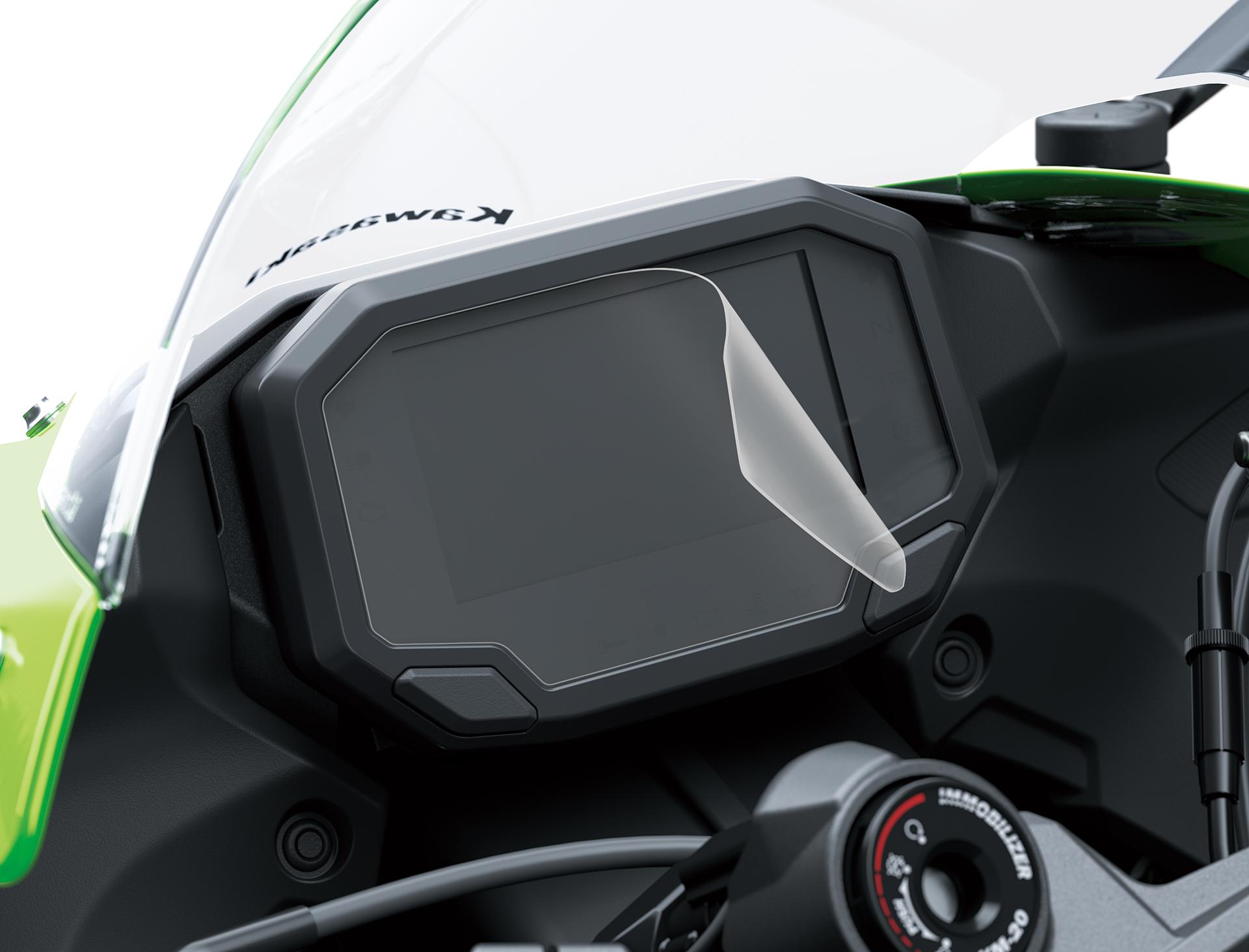
- Dashboard Screen Protector